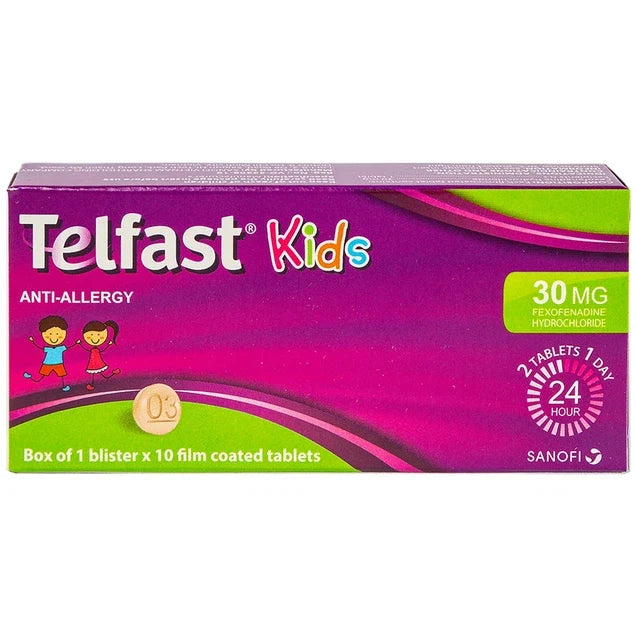
Telfast
Telfast Tablets 30mg for Children (60 Tablets)
Telfast Tablets 30mg for Children (60 Tablets)
Couldn't load pickup availability
Is Fexofenadine for Kids the Right Allergy Tablet?
If your child spends half of spring sneezing into their sleeve or rubbing their eyes through every lesson, you are not alone. Seasonal allergic rhinitis — commonly called hay fever — affects a significant number of school-age children in the UK, and finding a treatment that actually works without leaving them drowsy at their desk is a real challenge. Telfast Tablets 30mg for Children is a licensed, over-the-counter antihistamine tablet designed specifically for children aged 6 to 11 years. Each pack contains 60 tablets, giving you a solid supply through the allergy season. You can browse the full range of allergy and hay fever treatments at Cured Pharmacy if you want to compare options for the whole family.
The active ingredient is fexofenadine hydrochloride 30mg — a second-generation, non-sedating antihistamine. It is the same ingredient found in adult Telfast products, simply at a dose calibrated for younger bodies. Because it is non-sedating, it is far less likely to interfere with your child's ability to concentrate at school, play sport, or simply get through the day feeling like themselves.
How Does Telfast 30mg Work to Relieve Allergy Symptoms?
Allergy symptoms happen when the immune system overreacts to a harmless substance — pollen, pet dander, dust mites — and releases a chemical called histamine. Histamine then binds to receptors throughout the body, triggering the familiar cascade of sneezing, itching, watery eyes, and a blocked or runny nose.
- Fexofenadine selectively blocks peripheral H1 histamine receptors.
- By occupying those receptors, it prevents histamine from binding and triggering symptoms.
- It does not readily cross the blood-brain barrier, which is why it causes significantly less sedation than older antihistamines like chlorphenamine.
- Effects typically begin within one hour of taking the tablet and last for up to 12 hours, which is why it is dosed twice daily.
Who Should Use Telfast 30mg Children's Tablets?
Telfast 30mg is specifically licensed for children aged 6 to 11 years who experience symptoms of seasonal allergic rhinitis. It is not suitable for children under 6. If your child is 12 or older, they would typically move on to an adult-strength formulation. This product is ideal if your child experiences any of the following:
- Sneezing and a runny or blocked nose during pollen season
- Itchy, red, or watery eyes triggered by allergens
- Skin itching associated with allergic reactions
- Symptoms that worsen during spring and summer months
It is particularly well-suited to children who need to remain alert during school hours, as the non-sedating profile means it is unlikely to affect their concentration or performance.
How Does Telfast 30mg Compare to Other Children's Antihistamines?
| Feature | Telfast 30mg (Fexofenadine) | Piriton Syrup (Chlorphenamine) |
|---|---|---|
| Generation | Second-generation (non-sedating) | First-generation (sedating) |
| Drowsiness risk | Low | High — commonly causes sedation |
| Dosing frequency | Twice daily | Every 4–6 hours (up to 6 times daily) |
| Suitable age (OTC) | 6–11 years (30mg) | From 1 year (syrup formulation) |
| Duration of action | Up to 12 hours per dose | 4–6 hours per dose |
Is Telfast 30mg Safe to Store at Home and Use Long-Term?
Fexofenadine for kids is generally well tolerated when used as directed, and it does not carry the same sedation risks as older antihistamines. That said, it should always be stored below 25°C in a dry place, away from direct sunlight, and kept well out of reach of children. Do not use the tablets after the expiry date printed on the pack. If your child's symptoms persist beyond the allergy season or worsen despite treatment, it is worth speaking to your GP to rule out other causes or consider a referral to an allergy specialist. For children who also experience eye symptoms, you might find it helpful to explore eye care products that can complement antihistamine treatment.
This product is a medicine. Speak to your doctor or pharmacist before using if your child has an underlying medical condition or is taking other medicines.
Telfast Tablets 30mg for Children (60 Tablets) specifications
| Treatment category | Seasonal allergic rhinitis (hay fever) |
| Mechanism of action | Selective peripheral H1 histamine receptor antagonist |
| Effective | Within approximately 1 hour; lasts up to 12 hours |
| Suitable for | Children aged 6 to 11 years |
| Active ingredient | Fexofenadine hydrochloride 30mg |
| Pack sizes | 60 tablets |
| Strengths | 30mg |
| UK classification | P (Pharmacy medicine) |
| Drug class | Second-generation antihistamine |
| Preparation | Film-coated tablet |
| Route of administration | Oral |
Specifications of Telfast Tablets 30mg for Children (60 Tablets)
What Is Telfast 30mg and What Is It Used For?
Telfast Tablets 30mg for Children contains fexofenadine hydrochloride, a non-sedating antihistamine used to relieve the symptoms of seasonal allergic rhinitis in children aged 6 to 11 years. Seasonal allergic rhinitis is an allergic reaction triggered by airborne allergens — most commonly grass pollen, tree pollen, and mould spores — that causes the lining of the nose and eyes to become inflamed. Symptoms include sneezing, a runny or blocked nose, itchy eyes, and general nasal congestion. Telfast 30mg works by blocking the histamine receptors responsible for these reactions, providing relief that lasts up to 12 hours per dose.
It is classified as a Pharmacy (P) medicine in the UK, meaning it can be purchased without a prescription but should be selected with guidance from a pharmacist. It is not licensed for the treatment of perennial (year-round) allergic rhinitis in this age group at this strength.
What Do You Need to Know Before Using Telfast 30mg?
Before giving Telfast 30mg to your child, read the following carefully. There are certain situations where this medicine should not be used or should be used with caution.
Do not use Telfast 30mg if your child:
- Is under 6 years of age
- Is allergic to fexofenadine hydrochloride or any other ingredient in the tablet
- Has severe kidney (renal) impairment — consult a doctor first
Speak to your doctor or pharmacist before use if your child:
- Has any kidney problems, even mild ones
- Is taking any other medicines, including herbal remedies
- Has a known heart condition
Known drug interactions to be aware of:
- Antacids containing aluminium or magnesium hydroxide (e.g. some indigestion remedies) can reduce fexofenadine absorption — leave at least 2 hours between taking them
- Erythromycin and ketoconazole may increase fexofenadine plasma levels — seek medical advice before combining
- Fruit juices (grapefruit, orange, apple) significantly reduce absorption — always take with water only
How Should You Use Telfast 30mg Correctly?
Always follow the dosage instructions on the pack or as directed by your pharmacist. Do not give more than the recommended dose. Here is a step-by-step guide to using Telfast 30mg safely:
- Check that your child is aged between 6 and 11 years before giving this medicine.
- Give one 30mg tablet in the morning and one 30mg tablet in the evening — approximately 12 hours apart.
- Always give the tablet with a full glass of water. Never use fruit juice.
- The tablet can be taken with or without food.
- Do not give more than two tablets in any 24-hour period.
- If symptoms do not improve after a few days, consult your pharmacist or GP.
| Indication | Age Group | Dose | Frequency |
|---|---|---|---|
| Seasonal allergic rhinitis | 6–11 years | One 30mg tablet | Twice daily (morning and evening) |
| Seasonal allergic rhinitis | Under 6 years | Not recommended | — |
| Seasonal allergic rhinitis | 12 years and over | Use adult-strength formulation | — |
What Are the Possible Side Effects of Telfast 30mg?
Like all medicines, Telfast 30mg can cause side effects, although not everyone will experience them. Most side effects are mild and resolve without stopping treatment. If your child experiences anything severe or unexpected, stop the medicine and seek medical advice promptly. For children who also develop skin reactions alongside their allergy symptoms, it may be worth exploring skin care products suitable for sensitive or reactive skin.
Common side effects (may affect up to 1 in 10 children):
- Headache
- Nausea
- Dizziness
- Drowsiness (less common than with first-generation antihistamines, but possible)
Less common side effects (may affect up to 1 in 100 children):
- Fatigue or tiredness
- Insomnia or sleep disturbance
- Nervousness
- Abdominal pain or diarrhoea
Serious allergic reactions (hypersensitivity) to fexofenadine are rare but possible. Signs include swelling of the face, lips, or throat, difficulty breathing, or a severe skin rash. If any of these occur, stop the medicine immediately and call 999 or go to your nearest A&E.
How Should You Store Telfast 30mg Tablets?
Correct storage helps maintain the effectiveness and safety of the medicine throughout its shelf life. Follow these storage guidelines:
- Store below 25°C in a cool, dry place
- Keep away from direct sunlight and moisture
- Keep the tablets in their original blister packaging until use
- Store out of sight and reach of children at all times
- Do not use after the expiry date printed on the pack
- Do not dispose of medicines via household waste — return unused tablets to your local pharmacy for safe disposal
If you are managing multiple health products for your child, you might also find our ear, nose and throat range useful for complementary symptom relief during allergy season.
References
Written and reviewed by our qualified team
Your safety and success are our highest priorities. Our medical team rigorously evaluates every product and piece of advice we provide, ensuring you receive only the most effective, science-backed solutions available.
Frequently Asked Questions
Where can I buy Telfast 30mg for children online in the UK?
You can buy Telfast 30mg children's tablets directly from Cured Pharmacy, a GPhC-registered UK online pharmacy. It is available as an over-the-counter medicine, so no prescription is needed. Simply add it to your basket and it will be dispatched to your door, making it a convenient option during busy allergy seasons.
How does fexofenadine for kids work in the body?
Fexofenadine works by selectively blocking peripheral H1 histamine receptors, which are the receptors that histamine binds to when triggering allergy symptoms. By occupying these receptors, fexofenadine prevents histamine from causing sneezing, itching, a runny nose, and watery eyes. Because it does not readily cross the blood-brain barrier, it is far less likely to cause drowsiness than older antihistamines.
What age is Telfast 30mg suitable for?
Telfast 30mg tablets are licensed for children aged 6 to 11 years only. Children under 6 should not use this product, and children aged 12 and over should use an adult-strength fexofenadine formulation such as Telfast 120mg or 180mg. Always check the age suitability before purchasing any antihistamine for your child.
What is the correct dose of Telfast 30mg for a child?
The recommended dose for children aged 6 to 11 years is one 30mg tablet taken twice daily — once in the morning and once in the evening, approximately 12 hours apart. Never give more than two tablets in any 24-hour period. If you are unsure about the correct dose, speak to your pharmacist before giving the medicine.
When is the best time to give Telfast 30mg to my child?
The best approach is to give one tablet in the morning and one in the evening, spaced roughly 12 hours apart, to maintain consistent symptom control throughout the day. If your child's symptoms are worst in the morning — which is common during high pollen periods — giving the first dose as early as possible after waking can help. Taking it at the same times each day also makes it easier to remember.
Can Telfast 30mg cause drowsiness in children?
Telfast is classified as a non-sedating antihistamine, meaning it is significantly less likely to cause drowsiness compared to first-generation antihistamines such as chlorphenamine (Piriton). However, a small number of children may still experience mild sleepiness, particularly when first starting the medicine. If your child seems unusually tired after taking it, speak to your pharmacist.
Can my child take Telfast 30mg with fruit juice?
No — Telfast should never be taken with grapefruit, orange, or apple juice, as these can significantly reduce the amount of fexofenadine absorbed into the bloodstream, making the medicine less effective. Always give the tablet with a full glass of plain water. This is one of the most important practical points to remember when using this medicine.
What are the common side effects of Telfast 30mg in children?
The most commonly reported side effects include headache, nausea, and dizziness. These are generally mild and tend to resolve on their own without needing to stop treatment. Less commonly, children may experience fatigue, abdominal discomfort, or mild sleep disturbance. If side effects are persistent or worrying, contact your pharmacist or GP.
What should I do if my child misses a dose of Telfast 30mg?
If your child misses a dose, give it as soon as you remember — unless it is nearly time for the next scheduled dose. In that case, skip the missed dose and continue with the regular schedule. Never give a double dose to make up for a missed one, as this increases the risk of side effects without providing additional benefit.
How does Telfast 30mg compare to Piriton for children?
Telfast 30mg contains fexofenadine, a second-generation non-sedating antihistamine, while Piriton contains chlorphenamine, a first-generation antihistamine that commonly causes significant drowsiness. Telfast is generally preferred for daytime use in school-age children because it is far less likely to affect concentration, alertness, or academic performance. You can explore the full range of allergy and hay fever treatments to compare options.
Who is not eligible to use Telfast 30mg children's tablets?
Telfast 30mg is not suitable for children under 6 years of age, children with severe kidney impairment, or those with a known allergy to fexofenadine or any other ingredient in the tablet. Children taking certain antibiotics (such as erythromycin) or antifungals (such as ketoconazole) should be assessed by a doctor before using this medicine, as these can interact with fexofenadine.
How long can my child take Telfast 30mg for?
Telfast 30mg can be used throughout the allergy season, which in the UK typically runs from late March to September depending on the pollen type. If your child needs to use it for longer than the allergy season, or if symptoms persist year-round, it is advisable to speak to your GP to investigate whether there is an underlying cause that needs further assessment.
Can Telfast 30mg be taken alongside other allergy medicines?
Telfast 30mg can sometimes be used alongside other allergy treatments such as nasal corticosteroid sprays (e.g. fluticasone), but you should always check with your pharmacist or GP before combining medicines. Avoid giving it alongside other antihistamines, as this increases the risk of side effects without improving symptom control. If your child also has eye symptoms, consider looking at eye care products designed for allergy-related eye irritation.
What are the alternatives to Telfast 30mg for children with hay fever?
Alternatives include cetirizine (available as a syrup or tablet for children) and loratadine, both of which are also second-generation non-sedating antihistamines. Nasal corticosteroid sprays such as fluticasone or mometasone may be recommended by a GP for more persistent or severe nasal symptoms. The right choice depends on your child's specific symptoms, age, and any other medicines they are taking.
Is there any recent research on fexofenadine for kids with seasonal allergies?
Fexofenadine has been studied extensively in paediatric populations and is well-established as a safe and effective option for children aged 6 and over with seasonal allergic rhinitis. Clinical evidence consistently supports its non-sedating profile and efficacy in reducing sneezing, nasal congestion, and itchy eyes. It remains one of the most widely recommended antihistamines for school-age children in UK clinical practice.
Share